Has the AFLW had eNOFF of congested footy?
Will and Mel take a critical look at the impact of the revised Holding the Ball rule interpretation on the game and AFLW Fantasy scoring potential through the lens of the Adelaide v Saints R1 match
A new AFLW season invariably comes with a suite of rule interpretation changes for players and fans alike to get their head around. Last week, the AFL Commission announced several rules changes and tweaks in an attempt to promote free-flowing football and hopefully remedy the congestion problem that has plagued modern football. Those at AFL House have long held the belief that higher scoring football is a better product and have long seemed intent on legislating away from the ‘rolling maul’ of contested footy, and the AFLW has proven once again to be the perfect testing ground, for better or worse. Now in its tenth season, even the staunchest AFLW fan would agree that greater scoring would benefit the game, but as skills and speed of play have improved rapidly, so too have game plans aiming to shut those very things down.
In 2025, it is the holding the ball rule that has been put under the microscope. Ever a contentious rule due to its subjective nature, the umpires have once again been given a new set of instructions on how to adjudicate one of the most variable rules in our game. The current iteration of the ruling now stipulates that when a player is tackled without prior opportunity, they must make a genuine attempt to dispose of the ball – failure to do so will result in a free kick to the tackler regardless of how quickly they were tackled after gaining possession. The only reprieve is if the ball is knocked free in the tackle, allowing the umpire to call “play on!’ as the ball remains in motion; in short, as long as the ball keeps moving, play can continue.
The reasoning behind this interpretation is clear: keeping the ball moving at all costs to reduce congestion, and failure to do so will result in penalisation. Play will continue, stoppages will be reduced, and all going well, the ball will remain in play and scoring should follow - after all, a team can’t score if the ball is locked up and called back to the umpire for a ball-up! While this logical shift seems straightforward, across the first round of the AFLW season there were a couple of marked differences to how a standard game looked compared to previous seasons. No team exemplified how these changes can affect a team’s game style better than the Adelaide Crows.
An unexpected Round 1 from the Crows
Adelaide have been easily the best AFLW team across the ten seasons of the competition. Three flags from four grand finals and preliminary finalists for the last three seasons running, coach Matthew Clarke has built this Crows team for success based on possession dominance. They brutalise teams at the stoppage, with star skipper Ebony Marinoff and her midfield partner Anne Hatchard using their size and strength to wrench the ball from congestion or put on big tackles to hold it in if they don’t. It’s a simple formula – win it in the middle and get it out or hold it in so they can try again next time – but that formula looks to be under threat if their round one showing is enough to go on. Their 22-point loss to St Kilda, a team many would have expected them to soundly dispatch, threw up a number of alarm bells for those at West Lakes as the Saints not only out-hunted them, but neutralised the midfield impact that has held the Crows in such strong stead for so long. Round one can always throw up some loopy results, and the Crows may just have had an off day against a team on the rise, but the way the game has been tweaked ever so slightly due to the aforementioned rule changes could give some insight into why the Crows struggled so greatly.
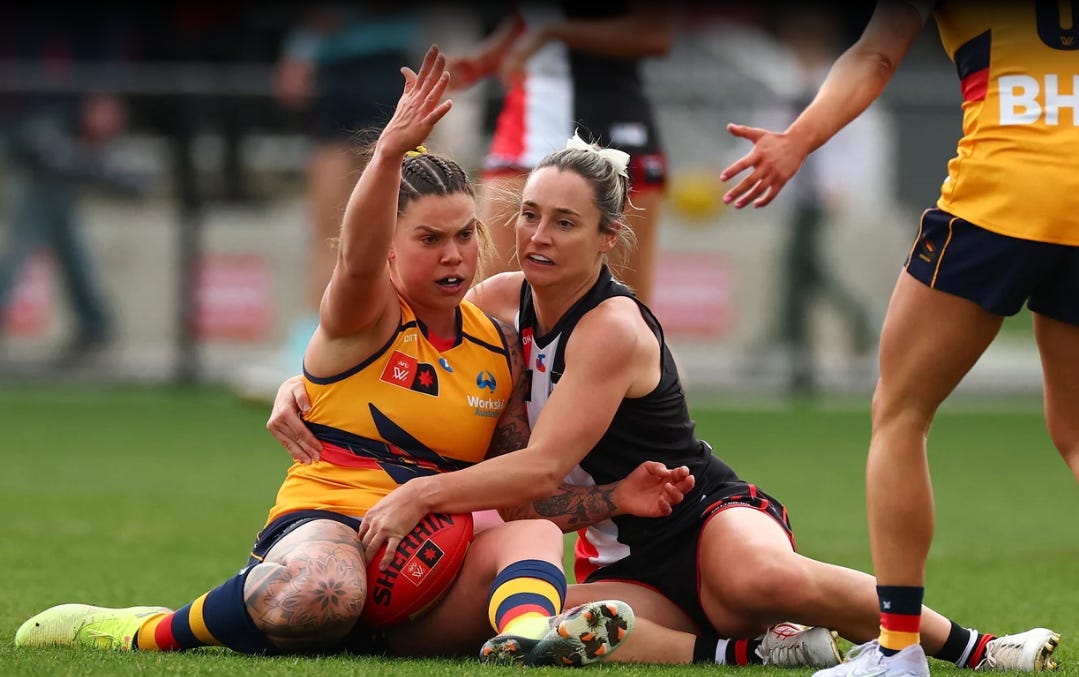
Anne Hatchard contests a ground ball with Nicola Stevens (image by Daniel Pockett/AFL Photos)
Tackling the midfield impact
Firstly, it was no surprise to see the free kick count from tackles was increased given the focus on rewarding the tackler. While this seems like an obvious effect of specifically looking to pay more holding the ball decisions, what was noticeable was how it affected teams with tackle-heavy game styles from 2024. North Melbourne, Fremantle, and Port Adelaide were the top three teams for total tackles in 2024 and liked to drag their opposition into contested games, where their powerful midfield could either force a clearance if they won possession or lock down a secondary stoppage if they did not. This advantage seems to have been tempered by the new holding the ball interpretation, as in their first game of this year each of these three teams conceded greater than expected frees against compared to their 2024 averages – North in particular conceded 23 free kicks compared to their 15.1 2024 average, with several sharp holding the ball calls being made across their match with the Cats. Normally these teams are happy to lock the ball in while in possession as a defensive ploy preventing their opposition from gaining possession, but due to the umpires actively looking to penalise players holding in the football, these teams were made to play a more open game style. This is exactly what the AFL wants, after all – less congestion, more open play – and will give these teams pause for thought on how they play.
Even though they don’t rank as high for tackles themselves, the ability of Adelaide’s star midfielders to get first use of the ball to either clear it or hold it in for a reset mean that if a clearance isn’t possible, holding it in to try again is the next best thing. However, this strategy seems to have backfired on the weekend as the Crows lost the clearances to the Saints, conceding 27 clearances to 19 and being penalised for holding it in on multiple occasions. This also quelled the influence of both Marinoff and Hatchard – both still had solid tackle numbers (8 and 4 respectively), but still less than their lofty 2024 standards. Marinoff was also well beaten around the clearances by Saints young gun Tyanna Smith who had a game high 7 clearances, suggesting that less opportunity for Adelaide to force stoppages, and then force clearance, was a key factor in St Kilda gaining ascendancy. Marinoff was also the one of the best examples from round one of having less of an impact around the stoppages, having 5 clearances for the match (below her 6.4 average from last year), with her bustling ‘see ball, get ball, kick ball’ style less effective when the umpires are so quick to pay holding the ball decisions.
Clearing out the clearances
This speaks to the second main difference seen in round one; that fewer stoppages naturally means there are fewer clearances to be had. While this is again an obvious correlation, the impact that this change in game flow will have on some of the competition’s biggest stars could be quite significant. Nearly every league Best and Fairest winner across the competition’s history has made their name as a contested ball-winner who dominates at the stoppages – Ebony Marinoff was top 3 for total clearances in 2024, while previous winners Emily Bates, Kiara Bowers, Mon Conti, and Bri Davey have all been top 5 clearance winners in seasons past. Throw in regular top clearance winners Jas Garner and Charlie Rowbottom to that list and you have a group of players who will have less of an opportunity to do what they arguably do best. Rowbottom, without her regular partner Claudia Whitfort, struggled the most, recording just 4 clearances - well below her league leading 7.6 average from season 9.
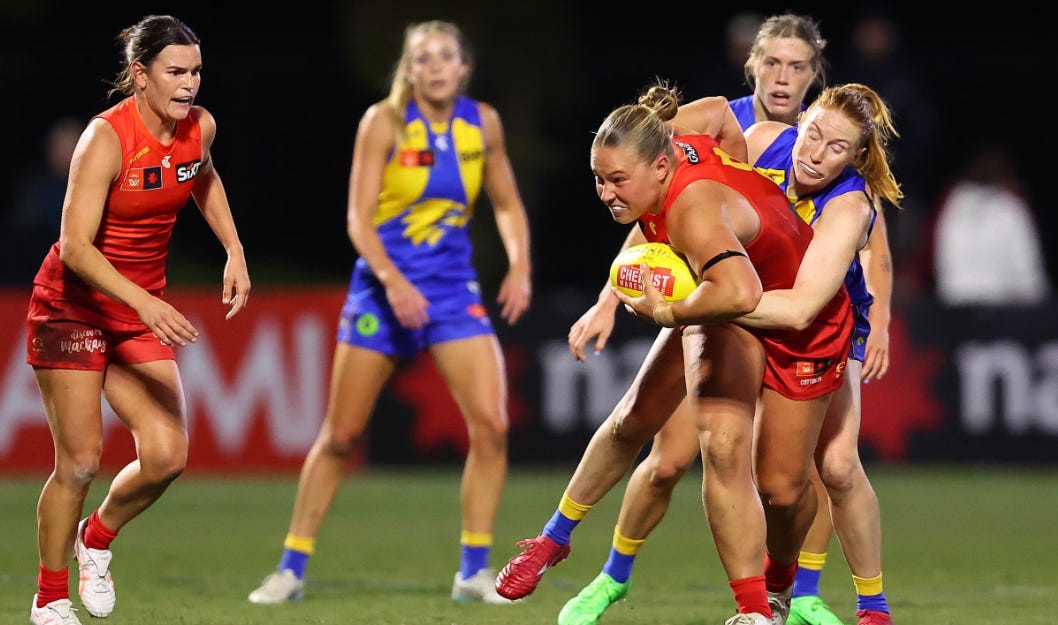
Charlie Rowbottom was well below her usual influence in Round One (image by Paul Kane/AFL Photos)
As the ball was being caught in congestion less, some of the league’s outside runners shone in the first round as their skills were used to maximum effect. This was again very noticeable at the Crows, as while Marinoff was still able to pick up a team high 29 disposals, it was wingers Madison Newman and Niamh Kelly who caught the eye in their loss to the Saints. Newman in particular had 23 disposals, 21 of which were kicks, and her and Kelly had a combined 1,092 metres gained. What is particularly noteworthy about this is they both far outstretched last year’s metres gained leader Marinoff, suggesting that the Crows were more willing to move it to the outside to push the ball forward rather than directly exiting from the stoppages. Other teams followed suit too, with wingers such as Geelong’s Mikayla Bowen, North’s Amy Smith, and Melbourne’s Eliza McNamara all impressing in their teams’ respective performances.
Hit outs hit a low
While much has so far been made on how stricter holding the ball rules affects the midfield playmakers, the impact is perhaps felt most by the league’s taller citizens, as less stoppages means far lower ruck contests. Ruck contest numbers were down roughly 33% compared to 2024 numbers, averaging just 22.8 per game across round one. As such, ruck hit outs were noticeably down with only Matilda Scholz recording more hit outs than her 2024 average, her 25 hit outs the second most for the week behind the Dogs’ Alice Edmonds with 27. Scholz’s efforts notably came against 2024 All-Australian ruck Mim Strom, who’s 14 hit outs were far below her average output of last year (36.8). Strom’s ability to impact around the ground with possessions (17 disposals against Port) and tackles (10 tackles) means she will continue to be an impactful player, we can once again return to the Crows to see how a high hit out ruck’s role might be impacted by these new rules – and in this case, be planned for.
Jess Allan was the second highest averaging ruck for hit outs last season, averaging a healthy 33.9 per match. This correlates with Adelaide’s desire to win stoppages or force them if they don’t, and as such her primary role was to use hit outs to service the Crows midfield. In AFLW Fantasy terms, her average of 65.4 was usually made up of about 50% hit outs, so if ruck contests have been reduced by 33% in 2025 so far, it would stand to reason that her fantasy scores would roughly follow that trend. Indeed, her hit out numbers were evidently down in their match against St Kilda, recording only 17 of them which was still the most of any player on the ground. However, the Crows looked to pivot her role away from “just hit outs” in a move that may suggest some planning for this outcome, as Allan managed to reach very close to her fantasy average from last year – 64 points. She had 14 disposals (one shy of her career high of 15) and 203 metres gained partly due to her 7 kicks, the most she has accumulated in a game to date. Allan was essentially playing as a fourth midfielder, trying to clear the area when given the ball as her fellow midfielders sought to dispose of the ball to free players, rather than hold it in and risk penalisation.
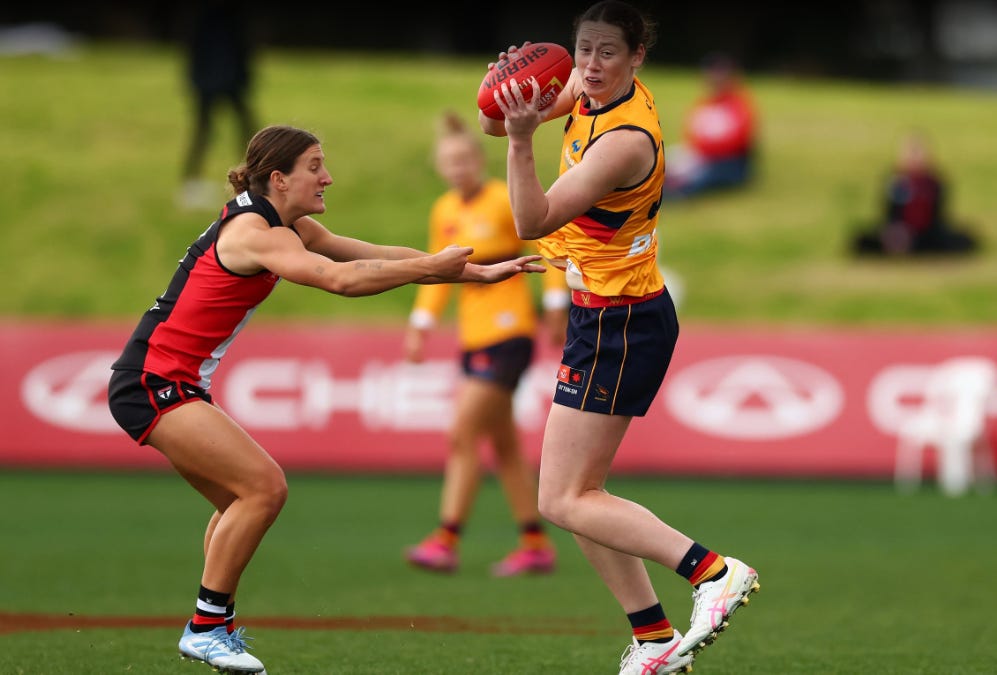
Jess Allan attempts to evade pressure from St Kilda’s Tyanna Smith (image by Daniel Pockett/AFL Photos)
So, does this mean an umpiring change has doomed Adelaide to their first season without finals since 2020’s cancelled season? Probably not – after all, Matthew Clarke hasn’t become a two-time premiership coach without having a few clues on working the game plan, and their list is still laden with top talent. But the Saints clearly got the jump on the Crows in a match that would concern those in the Adelaide camp, and they will have to correct course soon or risk falling back into the chasing pack. One match doesn’t define a season, but it can make clear areas for improvement and adaptation: clubs and fans alike will have to adjust quickly to the new adjudications or risk being left behind by the new free-flowing style of play the AFL is aiming for.
A little change never hurt
The new rule changes will inevitably have a teething period, with players penalised far too harshly after being instantly tackled obvious across the opening round, but overall, the reasoning is sound. With it, the game can progress quickly and fluidly, something that will improve both skill and spectacle, so it may not be the worst idea to leave congestion behind and embrace an umpiring change for good.
Keen for more?
Follow Free Kick wherever you get your podcasts
Subscribe to our Substack to stay on the pulse with the latest AFLW and AFLW Fantasy analysis from Free Kick